
TL;DR
Moving large parts of your accounting delivery to one BPO can solve capacity problems while creating a new dependency. Learn how to identify and reduce outsourcing concentration risk.
- Author
- WIS BPO
- Published
- Published
- Last updated
- Updated
- Reading time
- 5 min read
- Category
- Compliance
Outsourcing is usually introduced to reduce operational pressure. A good BPO relationship can provide additional bookkeeping capacity, VAT preparation, payroll support and accounts working papers without requiring another round of UK recruitment. Over time, the provider becomes familiar with the firm’s systems, clients and working methods, and the relationship can become increasingly efficient. That success can create a less obvious risk. A practice may gradually remove its dependency on individual employees while becoming heavily dependent on one external provider instead. Bookkeeping moves to the BPO. VAT preparation follows. Payroll is added. Eventually, accounts preparation and other recurring compliance work may sit with the same provider. As long as the relationship works well, this can feel like an efficient delivery model. The risk becomes visible only when the provider itself experiences disruption. This is BPO concentration risk.
What Is BPO Concentration Risk?
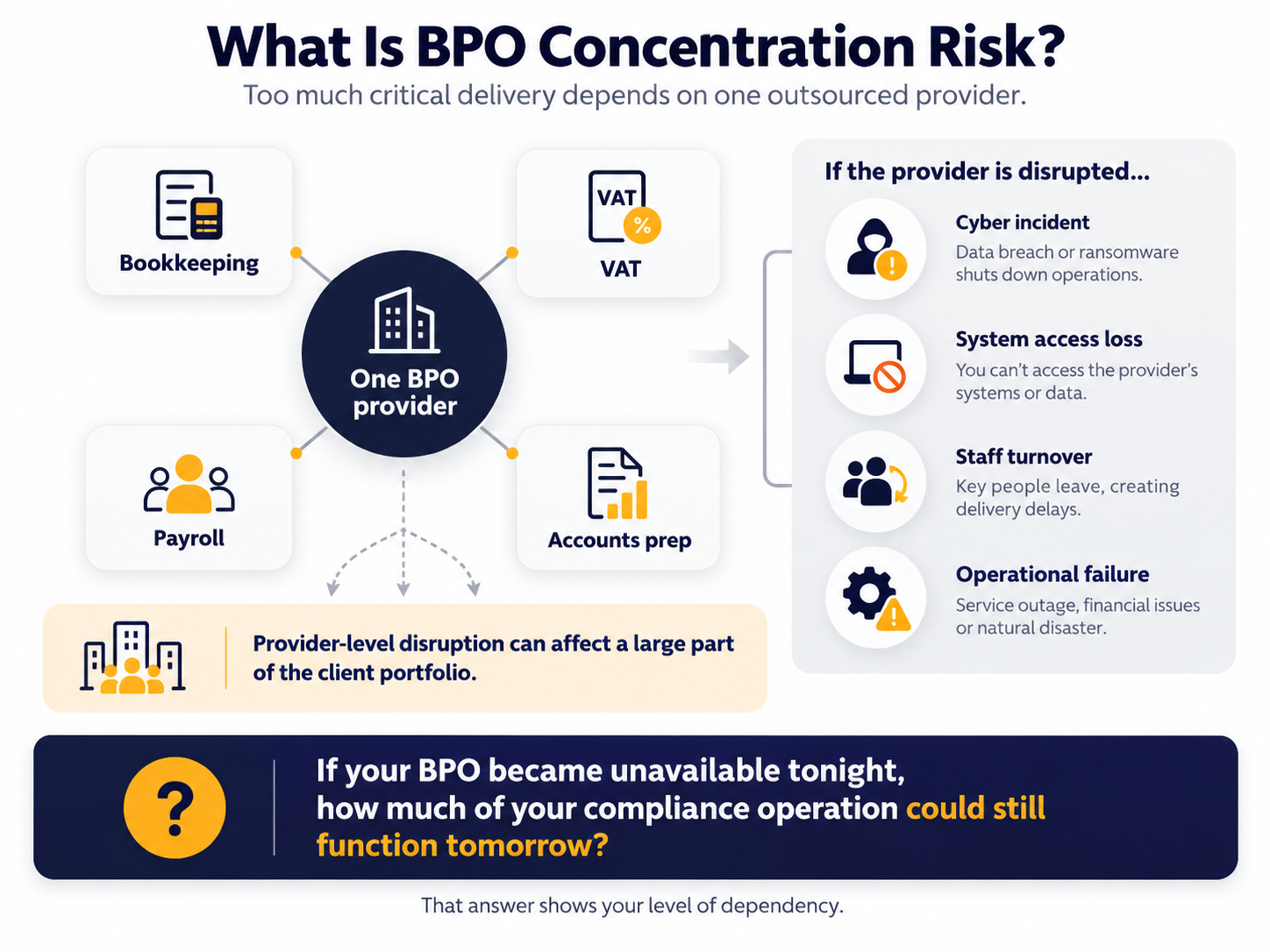
BPO concentration risk exists when too much of an accounting firm’s critical delivery depends on one outsourced provider. The concern is not simply that one accountant might be unavailable. A well-managed provider should have cover for individual staff absence. The bigger issue is provider-level disruption. A serious cyber incident, loss of system access, widespread staff turnover, financial difficulty or operational failure could affect several services at the same time. If one provider handles bookkeeping, VAT, payroll and accounts preparation, a single disruption may affect a large part of the practice’s client portfolio. A useful question for partners is: If your BPO became unavailable tonight, how much of your compliance operation could still function tomorrow? The answer gives you a practical indication of your level of dependency.
How Successful Outsourcing Creates Concentration Risk
Most firms do not deliberately decide to place the majority of their compliance delivery with one supplier. The dependency usually develops gradually. The provider may begin with bookkeeping. The work is good, so the firm sends more VAT preparation. That also works well, so payroll or accounts preparation is added. This progression is understandable. A long-term provider develops knowledge of the firm’s software, working-paper standards, recurring client issues and review expectations. That continuity can improve efficiency and reduce management time. The problem arises when there is no credible alternative if the provider suddenly becomes unavailable. At that point, efficiency has quietly turned into dependency.
Provider Failure Can Affect Several Workflows at Once
Concentration risk extends far beyond staff absence. A provider may experience a major cyber incident, lose access to essential systems, face unusually high staff turnover or encounter infrastructure problems. There may also be contractual disputes, financial instability, serious quality issues or data-security concerns that force the UK firm to suspend access. When several compliance services depend on the same provider, one incident can disrupt them all. The potential impact also varies depending on when the disruption occur
| Compliance Area | If BPO Unavailable for 24 Hours | If Unavailable for 2 Weeks |
|---|---|---|
| Bookkeeping | Small backlog begins | VAT and accounts work starts blocking |
| VAT preparation | Near-term jobs delayed | Filing deadlines may be threatened |
| Payroll | High impact near pay runs | Serious service disruption |
| Accounts preparation | Work queues grow | Filing pipeline becomes pressured |
| Management accounts | Reporting may slip | Client service suffers |
| Self Assessment | Often manageable off-peak | Significant risk during busy season |
Timing therefore matters as much as scope. Losing payroll support several days after payday is very different from losing it immediately before a major payroll run. BPO concentration risk should therefore be assessed by considering what is outsourced, how much is outsourced and how long each process can tolerate interruption.
One BPO Is Not Automatically the Wrong Strategy
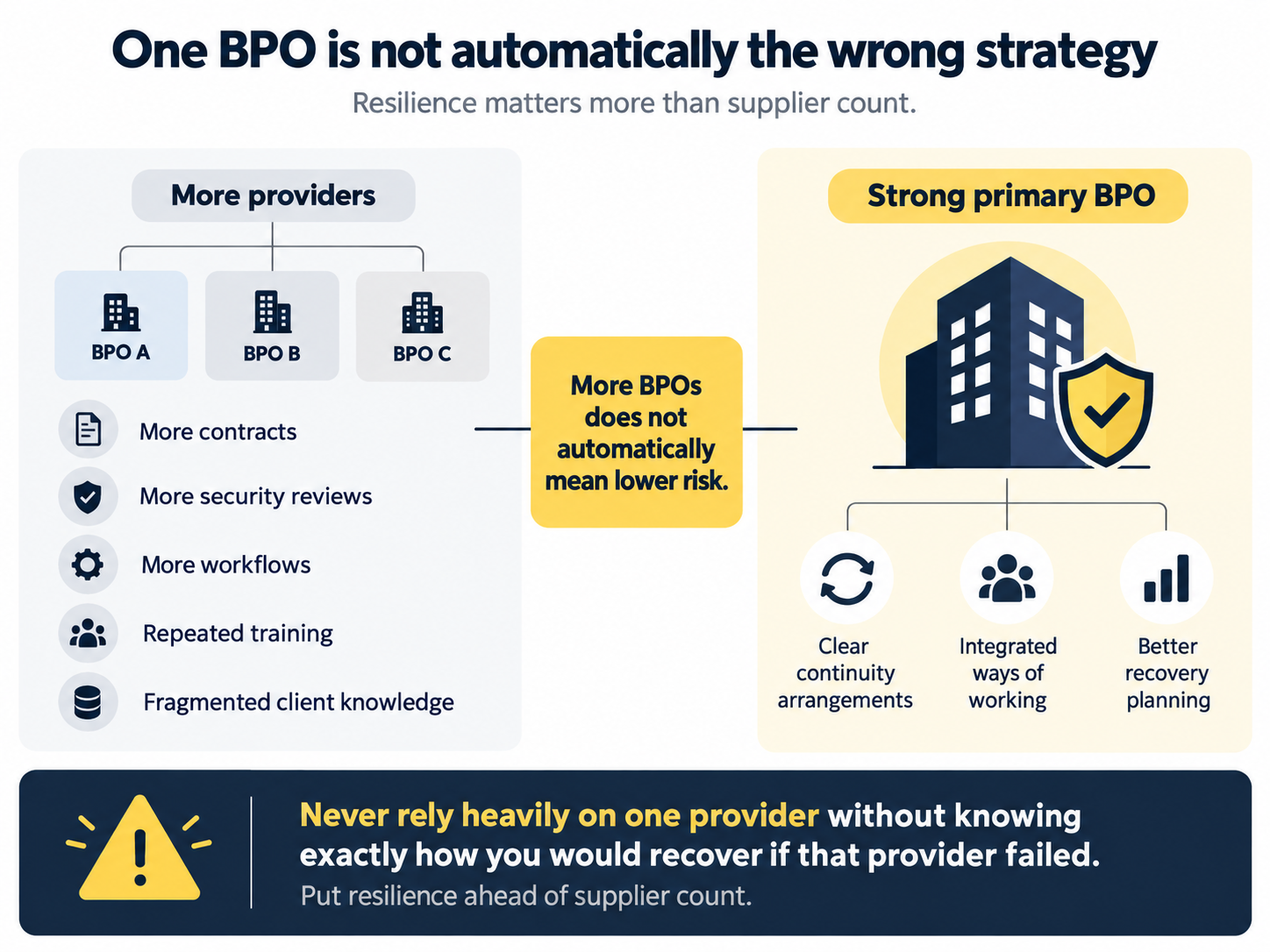
Reducing concentration risk does not necessarily mean appointing two or three outsourcing providers. A multi-BPO model can create its own problems. Each additional provider introduces another contract, another security assessment, another way of working and another management relationship. Teams may use different working papers, training may need to be repeated and client knowledge can become fragmented. In some cases, a strong primary BPO with good continuity arrangements may be safer than several poorly integrated suppliers. The goal should therefore not be to avoid relying heavily on one provider under all circumstances. A better principle is: Never rely heavily on one provider without understanding exactly how you would recover if that provider failed. That puts resilience ahead of supplier count.
Test the Provider’s Own Resilience First
Before adding a second outsourcing supplier, firms should understand how much redundancy already exists inside the current provider. A mature BPO should not depend on one accountant, one manager, one office or one undocumented process. Ask how absence cover works, how client knowledge is documented and whether more than one manager understands your portfolio. You should also understand where procedures are stored, whether work can continue from an alternative controlled location and how serious incidents are escalated. The provider should be able to explain how system access, backups and staff departures are managed as well. If these controls are strong, the practical concentration risk may be lower than it first appears. The real question is not simply whether you use one supplier. It is whether that supplier itself has multiple points of resilience.
Keep Critical Knowledge Inside the UK Firm
One of the most dangerous forms of dependency occurs when the BPO understands the delivery process better than the accounting firm does. The provider may operate the workflow every day, but the UK practice should still retain access to the knowledge required to run it. That includes standard operating procedures, client-specific instructions, current working papers, workflow status, open queries, filing evidence and deadline information. If the outsourcing relationship ended tomorrow, the firm should still be able to explain how each major process works. The BPO can operate the system. It should not become the only place where the system is understood. This principle becomes increasingly important as outsourcing relationships mature and more work moves externally.
Avoid Provider-Owned Data Silos
Concentration risk also increases when client data becomes trapped inside systems controlled only by the provider. Where practical, outsourced work should take place within systems that remain accessible and visible to the UK firm. The practice should know where working papers are stored, where work-in-progress information sits and how client records would be returned if the relationship ended. Exit arrangements should cover not only the final data transfer but also work currently in progress, open queries, temporary files and access removal. A provider relationship is far safer when changing supplier would be difficult but manageable. It becomes much riskier when changing supplier would make the underlying client operation impossible to reconstruct.
A Primary-and-Backup Model Can Be More Practical
Firms do not necessarily need to run two identical outsourcing arrangements simultaneously. A more practical approach may be a primary-and-backup model. The primary BPO handles the majority of recurring preparation work. The UK firm retains enough internal understanding to maintain critical or urgent workflows, while an alternative source of capacity is identified in advance for prolonged disruption. This does not mean duplicating every job or paying two providers to perform the same work. It means knowing where extra capacity could come from if the primary provider became unavailable for more than a short period. That might involve maintaining pre-approved external support, keeping selected processes internally or ensuring that certain high-risk services can be transferred quickly. The aim is resilience without unnecessary duplication.
Payroll Deserves Greater Continuity Protection
Not every outsourced accounting service carries the same operational risk. Payroll is particularly sensitive because the deadline is tied directly to employees being paid. A short disruption in accounts preparation can often be recovered over the following days. A short disruption to payroll immediately before payday may create a much more serious client-service problem. The same principle applies to other deadline-sensitive work. VAT preparation may tolerate some interruption early in the cycle but become critical as the filing deadline approaches. Firms should therefore rank outsourced services according to how long they can reasonably tolerate disruption. The shorter that tolerance, the stronger the backup arrangement should be.
Concentration Can Exist at Individual Level Too
A firm may contract with a large BPO and still have substantial key-person risk. If almost all client knowledge and escalation responsibility sits with one offshore manager, that individual can become another single point of failure. Partners should understand how client knowledge is distributed inside the provider. If the senior manager responsible for the portfolio leaves, does another manager understand the work? Are important decisions documented? Can another team step in without reconstructing years of history? Provider size alone does not demonstrate resilience. What matters is how your specific account is structured.
Review Concentration as the Relationship Grows
Concentration risk changes over time. A BPO relationship that represented only a small operational dependency two years ago may now support a large share of the practice’s bookkeeping, VAT, payroll and accounts work. The risk assessment should therefore evolve with the relationship. When outsourcing scope increases significantly, firms should revisit business continuity, internal knowledge, system access and exit arrangements. The objective is to recognise the dependency while it is still manageable. Waiting until the provider experiences a serious incident is too late to discover that the firm no longer knows how to operate without them.
Do Not Replace One Dependency With Another
Outsourcing should make an accounting practice more resilient. It should not simply move the single point of failure from an internal employee to an external supplier. The answer is not automatically to appoint more BPO providers. The stronger approach is to understand where dependency exists, keep critical knowledge accessible, protect key data and design a credible recovery path before it is needed. A well-managed firm should know what happens if staff disappear, systems fail or the outsourcing relationship ends unexpectedly. It should also know which services can tolerate disruption and which cannot. That is what turns outsourcing from a simple capacity solution into a resilient operating model. WIS BPO provides dedicated accounting support for UK practices through structured teams, documented workflows and defined continuity arrangements. Our model provides scalable preparation capacity while the UK practice retains visibility, client communication, technical responsibility and final approval.
FAQs
What is BPO concentration risk?
BPO concentration risk is the operational dependency created when a large proportion of important outsourced work relies on one provider. If that provider experiences a serious disruption, several accounting services may be affected simultaneously.
Should an accounting firm use more than one BPO?
Not necessarily. Multiple providers can improve resilience, but they can also increase management complexity and reduce consistency. A strong primary provider with tested continuity arrangements may be more effective.
How can firms reduce dependency on a BPO?
The firm should retain access to procedures, working papers, workflow information and client-specific knowledge. It should also test the provider’s business continuity arrangements and maintain a realistic recovery or backup option for critical services.
Which outsourced accounting service has the greatest continuity risk?
Payroll is often particularly sensitive because disruption close to payday has immediate consequences. VAT and filing work can also become high risk as statutory deadlines approach.
How often should BPO concentration risk be reviewed?
It should be reviewed whenever the outsourcing relationship grows significantly and as part of regular supplier-risk reviews.
Can a dedicated BPO still provide strong resilience?
Yes. Dedicated teams can be highly resilient when procedures, backup staff, management cover, access arrangements and client knowledge are properly documented.