
TL;DR
Hiring more accountants may sound like the obvious answer to rising compliance workloads, but recruitment delays, review bottlenecks and uneven demand mean headcount alone may not solve the problem.
- Author
- WIS BPO
- Published
- Published
- Last updated
- Updated
- Reading time
- 5 min read
- Category
- Compliance
The accounting talent gap is not simply a shortage of people. For many firms, the real issue is the gap between the volume of compliance work that must be delivered and the amount of usable, review-ready capacity the team can actually produce. That distinction matters because adding headcount does not automatically create immediate capacity. A firm may recruit two new accountants and still feel overloaded several months later. New hires take time to recruit, onboard, train and supervise, while the existing team continues to manage current deadlines and client work. This is why “just hire more people” is often too simple an answer to the 2026 compliance workload problem. The stronger approach is to understand how much productive capacity the firm genuinely has, where that capacity is being lost and which parts of the workflow are under the most pressure.
Headcount Is Not the Same as Capacity
A useful way to think about accounting capacity is: Usable capacity = available hours × productive utilisation × quality level An accountant may technically have 1,600 working hours available during the year, but that does not mean the firm receives 1,600 hours of productive compliance output. A significant amount of time will naturally be used for holidays, sickness, meetings, administration, client communication, technical research, training and internal support. Additional capacity can also disappear through rework, corrections and workflow delays. For example, if only 70% of an employee's available hours become productive delivery time, 1,600 hours becomes 1,120 productive hours. If part of that output then needs additional correction or review, the firm's effective first-pass capacity falls again. This is why headcount alone can give a misleading picture of how much work a team can actually deliver.
Recruitment Has a Built-In Delay
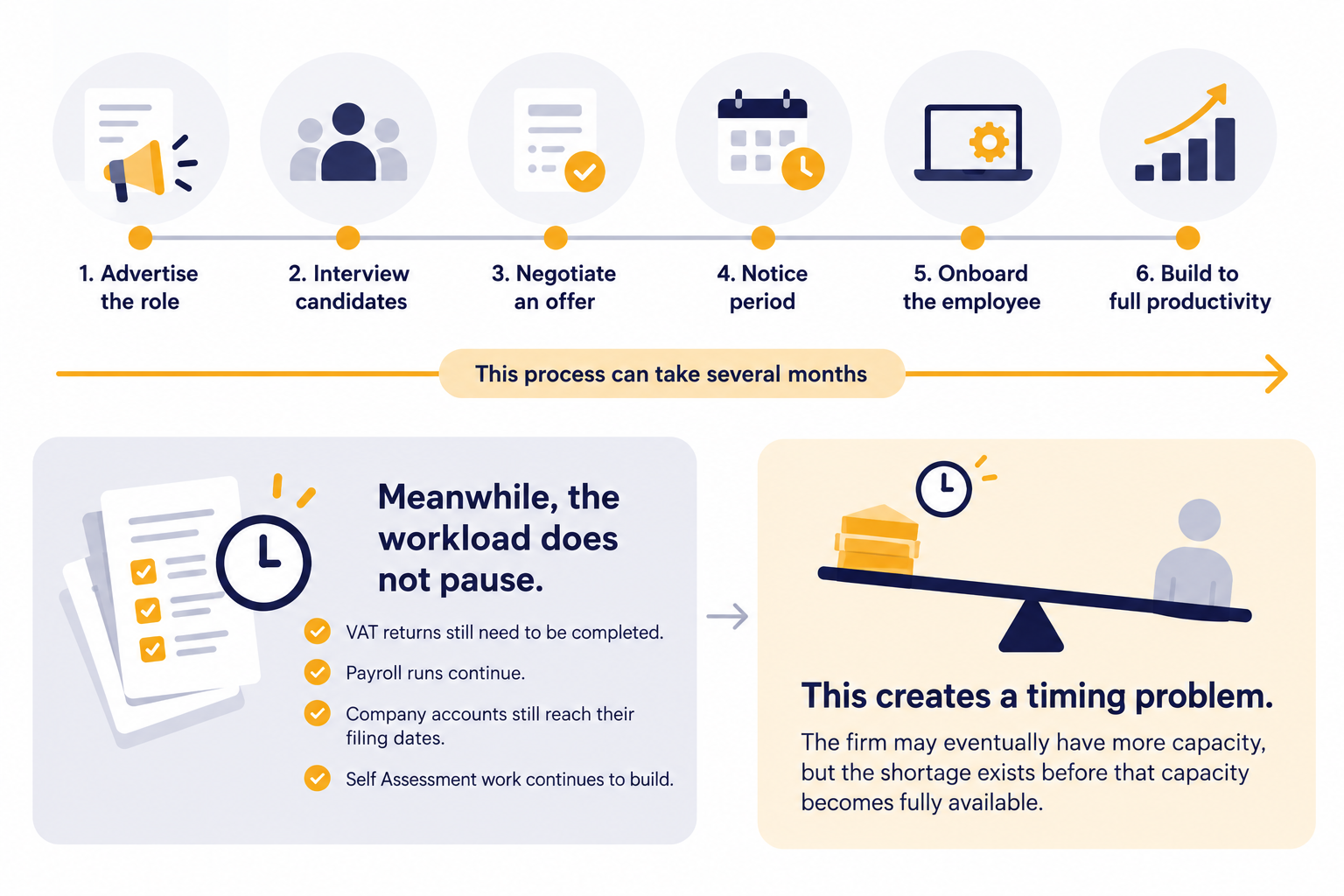
Hiring is often necessary, but the benefit rarely arrives immediately. Suppose your firm expects to need another 800 hours of compliance capacity over the next six months. If recruitment begins today, the process may involve advertising the role, interviewing candidates, negotiating an offer, waiting for a notice period, onboarding the new employee and then gradually bringing them up to full productivity. Even a successful recruitment process can take months before the new employee contributes at full capacity. Meanwhile, the workload does not pause. VAT returns still need to be completed. Payroll runs continue. Company accounts still reach their filing dates. Self Assessment work continues to build. This creates a timing problem. The firm may eventually have more capacity, but the shortage exists before that capacity becomes fully available.
New Employees Consume Capacity Before They Create It
One of the most overlooked aspects of recruitment is that new employees initially require support from the people who are already busy. Managers review their work more closely, senior staff answer questions and internal processes need to be explained. Some work will need to be corrected or returned for further preparation. This means a new employee can temporarily reduce senior capacity before creating a net gain. For example, a new accountant may add 25 preparation hours per week, but if a manager spends six hours reviewing, training and answering questions, the immediate net gain is closer to 19 hours. That can still be worthwhile, but it is very different from assuming that one new employee creates one full unit of productive capacity from day one.
The Review Bottleneck Can Cancel Out New Preparation Capacity
Preparation is only one stage of compliance delivery. Prepared work still needs to be reviewed. If five accountants are already preparing work for one overloaded manager, hiring a sixth preparer may not solve the real problem. It may simply increase the size of the review queue. The same principle applies to other bottlenecks.
| Capacity Problem | What Hiring Adds | What May Still Remain |
|---|---|---|
| Too much bookkeeping | More preparation hours | Potentially resolved |
| Accounts review backlog | More junior output | Review bottleneck remains |
| Partners answering routine queries | More staff | More questions without better systems |
| Poor working-paper quality | More output | More rework |
| Late client records | More employees | Same waiting time |
| Seasonal workload spikes | Permanent capacity | Excess capacity later |
| Weak workflows | More people in same process | Same inefficiency |
| Technical skills shortage | General accountant | Specialist gap remains |
The key point is that the real constraint is often not the number of employees. It is the narrowest point in the workflow.
One New Hire Does Not Equal One Full Unit of Capacity
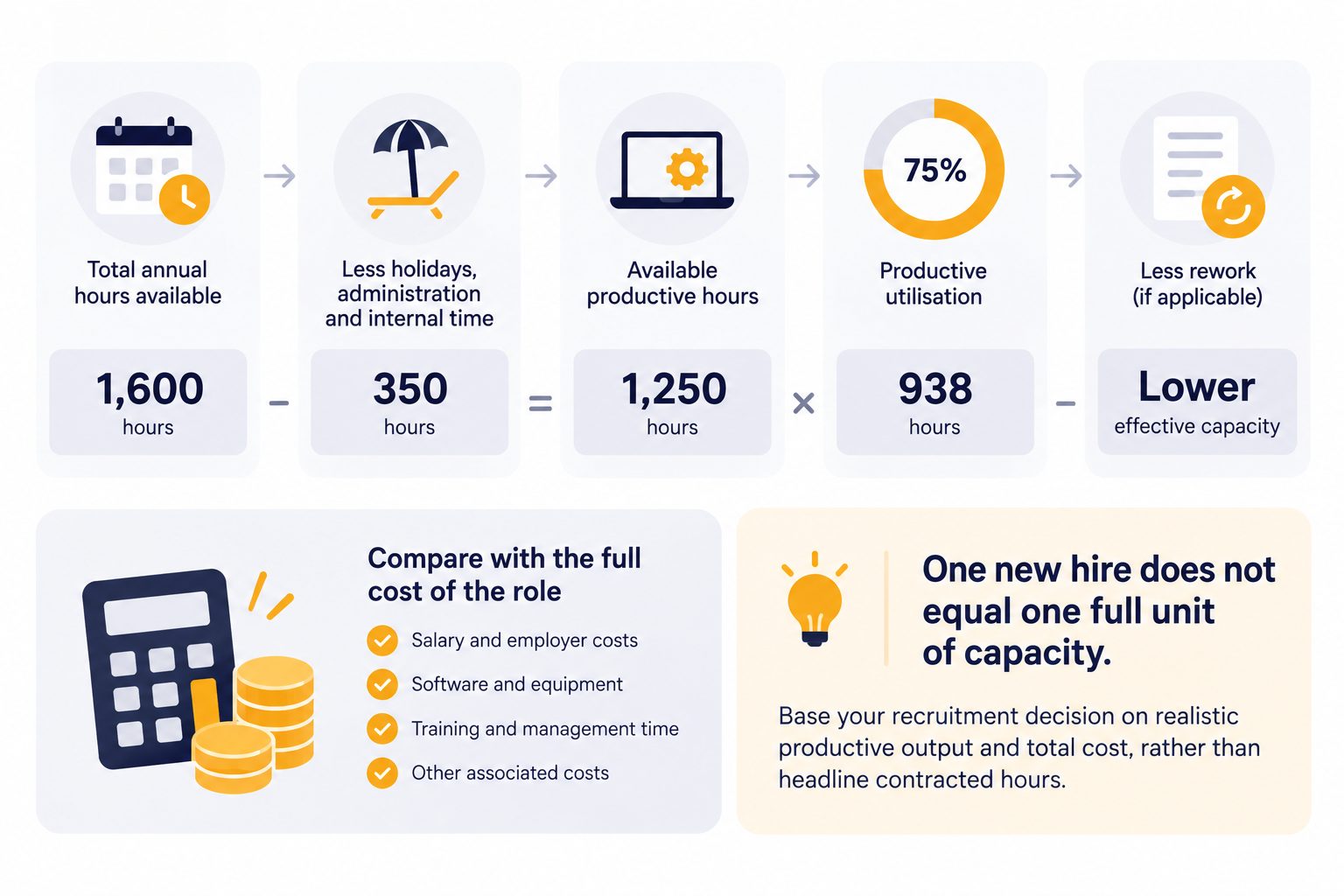
When planning recruitment, firms should calculate what capacity they are actually buying. Imagine an accountant has 1,600 available hours during the year. Once holidays, administration and internal time are removed, perhaps 1,250 remain. If productive utilisation is around 75%, that may result in approximately 938 hours of client-facing or compliance work. If some of that output requires rework, the effective capacity is lower again. The firm should then compare that realistic output with the full cost of the role, including salary, employer costs, software, equipment, training and management time. This does not mean recruitment is a bad investment. It means the business case should be based on realistic productive output rather than headline contracted hours.
Seasonal Work Makes Permanent Hiring More Complicated
Compliance workloads rarely arrive evenly across the year. January can create intense Self Assessment pressure. VAT deadlines generate regular workload spikes. Company year ends may cluster around particular months, and payroll creates fixed monthly deadlines. A firm may therefore need the equivalent of several additional accountants during a peak period but much less extra capacity during quieter months. Hiring enough permanent employees to cover the busiest period may create unused capacity later. Hiring only for the average workload avoids excess fixed cost, but the firm may still struggle during peak periods. This mismatch is one reason flexible capacity has become increasingly important.
The Talent Gap Is Also a Skills Gap
Not every accounting hour is interchangeable. A shortage of bookkeeping capacity is different from a shortage of review capacity. A newly qualified accountant cannot always replace an experienced manager, and a senior accountant should not spend most of the week completing basic reconciliations. Capacity needs to be matched to the level of work. A firm may simultaneously have enough accounts preparation capacity, too little bookkeeping support, insufficient manager review capacity and too much partner involvement. Hiring another general accountant may help with part of the problem but leave the other constraints untouched. This is why capacity planning should separate preparation, review and technical work rather than treating them as one staffing number.
Fix Workflow Problems Before Adding More Headcount
If the existing team is losing significant time through avoidable rework and poor workflow, hiring more people simply increases the number of employees working inside an inefficient system. Before recruiting, firms should review where time is being lost. Useful measures include:
- Jobs reopened because information was incomplete
- Review points per file
- Time spent chasing clients
- Partner hours spent on routine compliance
- Jobs waiting for review
- Average turnaround time
- Repeated internal questions
If process improvements remove hundreds of hours of avoidable work, the firm may reduce the size of its recruitment requirement. That is often a faster and cheaper way to create capacity.
Outsourcing Changes the Capacity Equation
Outsourced accounting support gives firms another way to increase capacity without recruiting every role internally. A dedicated support team can handle structured and repeatable work such as bookkeeping, bank reconciliations, VAT preparation, payroll support, accounts working papers and routine management account schedules. The UK team can retain responsibility for client communication, technical judgement, review and final approval. The value of this model is not simply lower cost. It allows the firm to separate preparation capacity from higher-level internal roles. For example, a practice may decide that managers and advisers should remain internal while a scalable outsourced team supports recurring preparation work. This can help firms create more flexible capacity without adding permanent headcount for every increase in workload.
Calculate the Real Capacity Gap
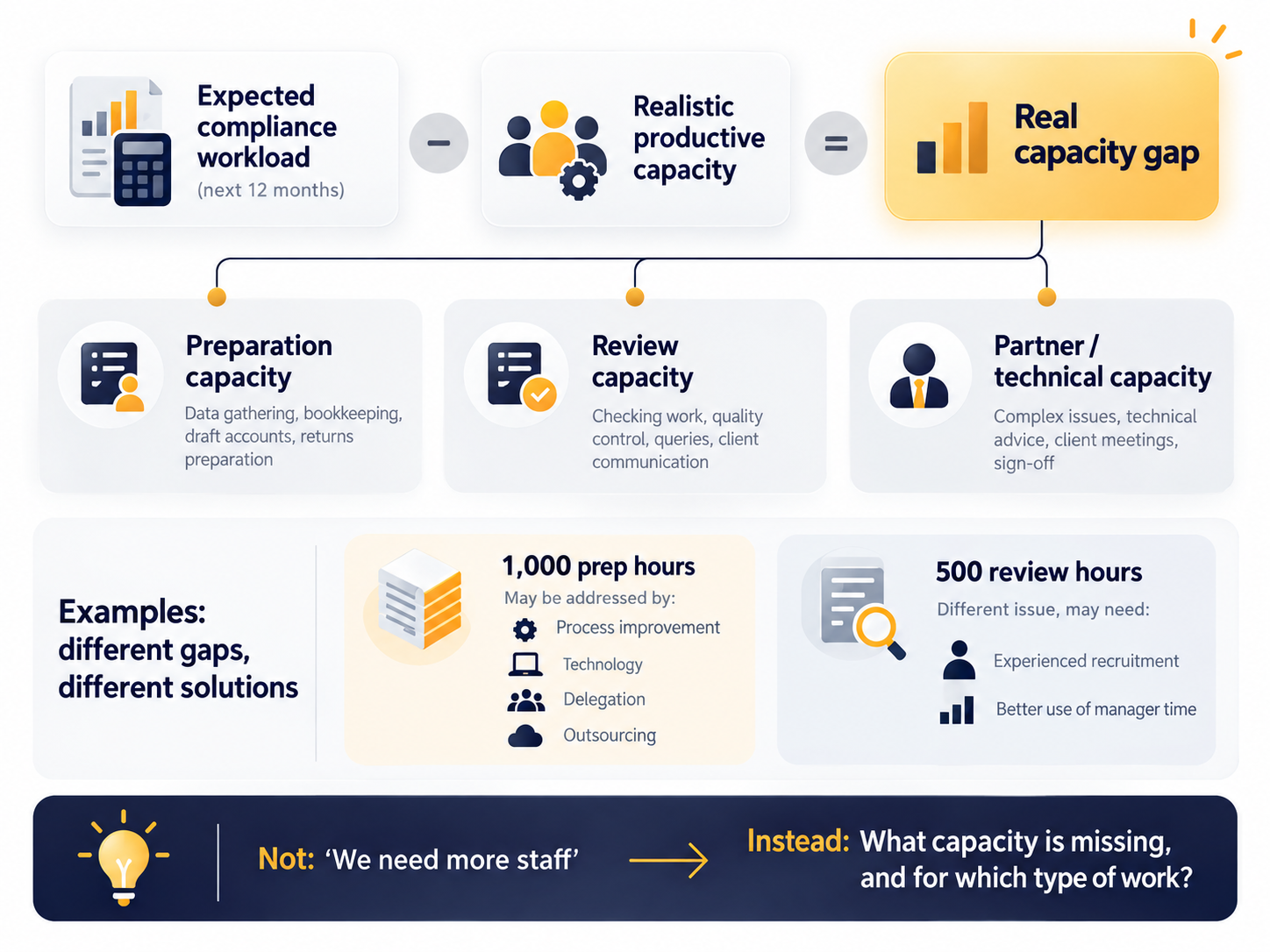
A better staffing exercise starts by estimating the firm's expected compliance workload for the next 12 months and comparing it with realistic productive capacity. The gap should then be divided into separate categories:
- Preparation capacity
- Review capacity
- Partner or technical capacity
This produces a much more useful staffing plan. A shortage of 1,000 preparation hours may potentially be addressed through process improvements, technology, internal delegation or outsourcing. A shortage of 500 high-level review hours is a different problem and may require experienced recruitment or a change in how manager time is used. Saying “we need more staff” is too broad to guide a good decision. The question should be: what level of capacity are we missing, and for which type of work?
Recruitment Still Matters
The argument is not that firms should stop hiring. Recruitment remains essential for roles that require internal expertise, leadership, specialist knowledge and long-term client relationships. The issue is relying on permanent hiring as the only solution to every capacity problem. A stronger model combines recruitment with better workflows, automation, improved role allocation and flexible preparation support. That allows the firm to recruit more deliberately rather than using headcount to compensate for every inefficiency.
The Capacity Problem Is Bigger Than Headcount
The 2026 accounting talent gap cannot be solved simply by counting empty desks and filling them. Firms need to understand how many productive hours they genuinely have, where those hours are being lost and which part of the delivery process is under pressure. Sometimes the answer will be recruitment. In other cases, automation, better processes or outsourced preparation support may create capacity more quickly or more flexibly. For many firms, the strongest model will combine all of these approaches. WIS BPO provides dedicated accounting support for UK practices that need scalable preparation capacity without relying entirely on permanent recruitment. Our teams support recurring compliance work within agreed systems and review structures, while the UK practice retains client relationships, technical responsibility and final approval.
FAQs
Why does hiring not always solve accounting workload problems?
New employees take time to recruit and train, while managers must supervise and review their work. Hiring also does not automatically fix poor workflows, late client records or review bottlenecks.
What is an accounting capacity gap?
An accounting capacity gap is the difference between the amount of work the firm needs to deliver and the effective productive capacity available to prepare, review and complete that work.
How should accounting firms calculate staffing requirements?
Firms should estimate expected workload by task type and compare it with realistic productive hours rather than total contracted hours. Preparation, review and partner capacity should be considered separately.
Can outsourcing help with the accounting talent gap?
Yes. Outsourced teams can provide recurring preparation capacity while the internal UK team focuses on review, technical work and client relationships.
Should accounting firms stop recruiting?
No. Recruitment is still important. The better approach is to recruit for roles that genuinely require internal expertise rather than assuming every additional compliance hour requires another permanent employee.
What should firms fix before hiring?
Review client information collection, rework, workflow ownership, standardisation, review bottlenecks and senior time leakage. Removing avoidable work can significantly reduce the amount of new capacity required.