

TL;DR
Accounting partners are often overloaded not because there is simply too much work, but because routine compliance tasks keep escalating upwards. Better workflows, clearer delegation and stronger preparation capacity can help protect senior time.
- Author
- WIS BPO
- Published
- Published
- Last updated
- Updated
- Reading time
- 5 min read
- Category
- Compliance
Accounting partners rarely become overloaded because every task on their desk genuinely requires partner-level expertise. More often, they become overloaded because routine compliance work keeps moving upwards through the firm until it reaches the most senior person available. A client sends incomplete information, a preparer starts the job anyway, a reconciliation does not balance, a manager is already busy and the deadline keeps getting closer. Eventually, the file reaches the partner because somebody has to make sure it gets finished. At that point, the partner often has little choice but to step in. This may solve the immediate problem, but it creates a much bigger long-term issue. When partners repeatedly rescue work that should have been resolved earlier, the firm begins to rely on senior people as the final safety net for routine compliance. That is not a sustainable operating model.
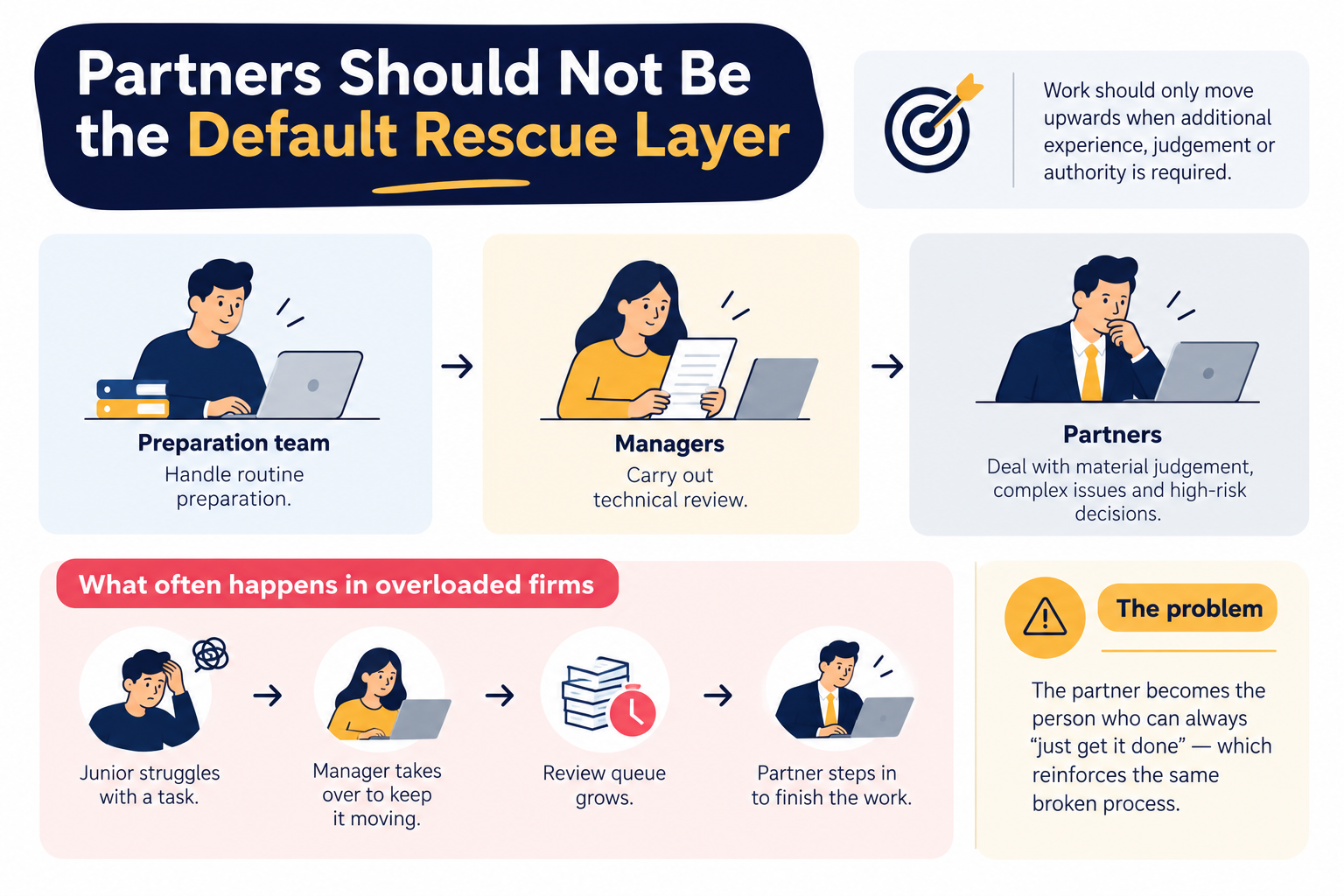
Partners Should Not Be the Default Rescue Layer
In a healthy accounting firm, work should only move upwards when additional experience, judgement or authority is genuinely required. Routine preparation should remain with the preparation team. Technical review should sit with managers. Material judgement, complex client issues and high-risk decisions should move to partners. In many overloaded firms, however, almost everything eventually travels upwards. A junior team member may struggle with a reconciliation. A manager may take over the preparation because they want to keep the job moving. The review queue then grows because the manager has less time available for review. As deadlines get tighter, the partner steps in to finish the work. The partner becomes the person who can always “just get it done”. That behaviour protects the client in the short term, but it also reinforces the same broken process. The next time something goes wrong, everyone knows the partner will eventually rescue it again.
The Real Problem Is Upward Escalation
One of the most important issues in compliance workload management is what could be described as upward escalation. Every unresolved problem becomes more expensive as it moves through the firm. A relatively simple preparation issue may begin with a junior accountant. If it is not resolved at that level, it moves to a senior accountant, then to a manager and eventually to a partner. The work itself has not necessarily become more valuable. It has simply reached a more expensive person. For example, a reconciliation problem that could have been resolved during preparation may eventually require partner time because the deadline is now too close to send the job back. That is a poor use of senior capacity. The aim should be to resolve routine issues as low in the workflow as is appropriate, while escalating only those matters that genuinely require more experienced judgement.
Partners Are Often Doing Work Below Their Level
One of the clearest signs of an inefficient operating model is when partners regularly perform tasks that should have been completed earlier in the process. This might include chasing bookkeeping records, correcting basic coding errors, clearing bank reconciliations, organising files, preparing routine schedules or checking whether jobs have even been started. These tasks may need to be done, but they should not routinely sit in a partner's diary. When this happens repeatedly, the problem is not that the partner needs better time-management techniques. The problem is that the firm's delivery structure is allowing work to reach the wrong level. The solution is therefore not simply to make partners work faster. The work itself needs to be moved to the appropriate part of the team.
Manager Overload Often Creates Partner Overload
Partner pressure frequently begins one level below. Managers are supposed to review work, coach team members, oversee workflow and deal with more complex issues. However, when preparation capacity is weak, managers are often pulled back into doing the work themselves. They start preparing accounts, clearing backlogs and completing urgent tasks. This creates a chain reaction. When managers spend too much time preparing, they have less time to review. When review queues grow, more work remains unresolved. As deadlines approach, partners become involved because somebody senior needs to make the final decisions. The partner problem is therefore often the final symptom rather than the original cause. A firm that wants to reduce partner workload should first look at what is happening lower down the workflow.
Track Workflow, Not Just Statutory Deadlines
Many firms only become concerned when a statutory deadline begins to approach. That is too late. A job may not be due for another month, but it can still be at risk if the client has not supplied records, the bookkeeping is unfinished or the file has been waiting for review for several weeks. These are early warning signs. Instead of monitoring deadlines alone, firms should track the stage of each job. Useful stages might include:
- Waiting for client information
- Ready for preparation
- In preparation
- Awaiting review
- Returned for correction
- Awaiting client approval
- Ready to file
This gives managers a much clearer picture of where work is becoming stuck. If a job remains in one stage for too long, the firm can intervene before it becomes a partner-level emergency.
Too Much Knowledge Often Lives in Partners' Heads
Another reason partners become overloaded is that they hold too much operational knowledge personally. They may know which clients are difficult, how unusual balances were handled last year, which review points matter and how certain recurring issues are normally resolved. This can work when the firm is small. As the practice grows, however, team members begin asking the partner the same questions repeatedly. “What did we do last year?” “How does this client normally work?” “Can you quickly look at this?” The partner effectively becomes the firm's internal search engine. This creates constant interruptions and makes the wider team dependent on one person's memory. The solution is to document recurring knowledge. Client-specific notes, standard working papers, process guides and clear review instructions allow the partner's knowledge to strengthen the system rather than remain trapped inside one person's head.
Not Everything Should Be Treated as Urgent
Weak compliance workflows often create a culture where everything feels urgent. Late records arrive, VAT deadlines get closer, payroll changes appear unexpectedly and accounts filing dates begin to approach. When everything becomes urgent, partners spend much of their time switching between unrelated problems. That constant context switching reduces productivity and makes it harder to focus on high-value work. A better approach is to create internal deadlines well ahead of statutory deadlines. For example, a VAT return due next week should not suddenly become important next week. Preparation, review and approval should already have been scheduled earlier. Internal deadlines create room for problems to be identified and resolved before they become emergencies.
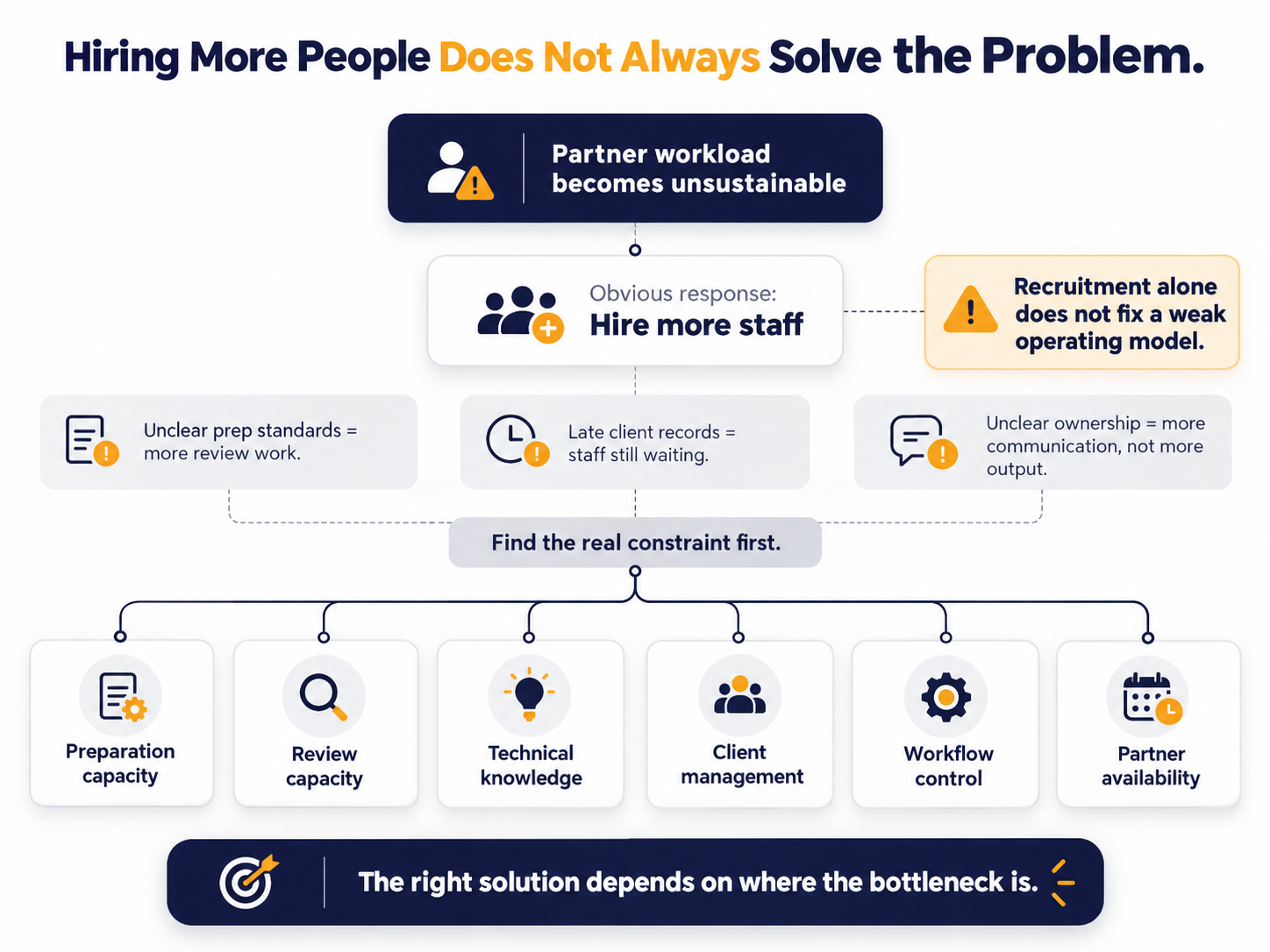
Hiring More People Does Not Always Solve the Problem
When partner workload becomes unsustainable, the obvious response is often to recruit more staff. Sometimes this is necessary, but recruitment alone does not fix a weak operating model. If preparation standards are unclear, new staff can create more review work. If clients are consistently late with information, additional accountants may simply sit waiting for the same missing records. If workflow ownership is unclear, more people can create more communication rather than more output. Before hiring, firms should identify where the actual constraint sits. Is the problem preparation capacity? Review capacity? Technical knowledge? Client management? Workflow control? Or partner availability? The answer determines the right solution.
Routine Work Should Be Completed at the Right Level
A firm can technically have enough employees and still use them inefficiently. Senior accountants may spend hours doing bookkeeping. Managers may prepare accounts. Partners may complete final reconciliations. The work gets done, but at a much higher cost than necessary. Routine compliance work should generally be completed at the lowest appropriate level while maintaining quality and control. That may involve junior staff, automation, improved systems or outsourced preparation support. Senior employees should then be available for the work that genuinely requires their experience. This improves both efficiency and staff utilisation.
How Outsourcing Can Reduce Partner Pressure
Outsourcing is most effective when it strengthens the preparation layer of the firm. A dedicated outsourced accounting team can support structured and repeatable work such as bookkeeping, bank reconciliations, VAT preparation, payroll support, accounts working papers and routine management accounts schedules. The UK firm can retain responsibility for client communication, technical decisions, review and final approval. The objective is not to remove partners from compliance altogether. It is to ensure that they only enter the workflow when partner-level input is genuinely required. When routine preparation is completed consistently and to an agreed standard, managers can focus more effectively on review and partners can focus on judgement, risk and client advice.
Clear Escalation Rules Protect Senior Time
Every firm should define what belongs at each level of the workflow. For example:
| Level | Typical Responsibility |
|---|---|
| Preparation team | Standard processing, reconciliations and working papers |
| Manager | Review, complex exceptions and workflow oversight |
| Partner | Material judgement, high-risk issues and client advice |
If something moves upwards, there should be a clear reason. A partner should not receive a vague message asking, “Can you look at this?” A better escalation would explain the issue, what has already been checked and exactly what decision is required. This reduces unnecessary interruptions and allows partners to focus on genuine decision-making rather than investigating routine problems from the beginning.
Protect Partner Time Deliberately
Partner time will not protect itself. If a partner's diary remains open to routine compliance rescue work, that space will eventually be filled. Firms need to protect time for activities such as client advice, business development, pricing, leadership, complex reviews and strategic decision-making. This does not mean partners should never become involved in compliance. It means that routine rescue work should be the exception rather than the normal operating model. The best way to achieve this is to strengthen the layers below the partner.
Run a Partner Rescue Audit
One useful way to identify the problem is to track partner activity for a week. Record every task that ideally should have been resolved earlier in the workflow. This may include:
- Client chasing
- Preparation
- Rework
- Review
- Internal questions
- Workflow management
- Deadline rescue
Then calculate how much time these activities consume. The result can be revealing. A partner may appear to have a workload problem, but the real issue may be a work-allocation problem. That is often easier to fix.
Partners Should Be the Final Decision Layer, Not the Final Labour Layer
Partners are rarely overwhelmed because they have too much genuinely strategic, partner-level work. More often, they are overwhelmed because routine compliance work keeps reaching them. The solution is not simply to ask partners to work harder or manage their diaries better. The firm needs a stronger operating model. That means improving preparation quality, protecting review capacity, documenting recurring knowledge, creating earlier internal deadlines and establishing clearer escalation boundaries. When the workflow is designed properly, partners remain involved where their experience creates the most value. They become the final decision layer rather than the final labour layer. WIS BPO supports UK accounting practices that want to reduce routine preparation pressure and build a stronger delivery layer beneath managers and partners. Our teams support recurring compliance work within agreed workflows, while the UK practice retains client relationships, technical responsibility, professional oversight and final approval.
FAQs
Why are accounting partners overloaded?
Accounting partners often become overloaded because routine preparation issues, client delays and review bottlenecks continually escalate upwards. The partner becomes the default person responsible for protecting deadlines and resolving unfinished work.
How can accounting firms reduce partner compliance work?
Firms can reduce partner involvement by strengthening preparation capacity, standardising working papers, introducing earlier internal deadlines and creating clear escalation rules.
Does hiring more accountants reduce partner workload?
It can, but only when preparation capacity is the real constraint. Hiring more staff will not automatically fix weak workflows, review bottlenecks or unclear ownership.
Can outsourcing help partners reclaim time?
Yes. Outsourced preparation teams can handle repeatable compliance work while UK managers and partners focus on review, technical matters, client communication and higher-value decisions.
What work should accounting partners focus on?
Partners should generally focus on material judgement, complex technical issues, high-value client advice, risk decisions, business development and firm leadership.
How can firms identify unnecessary partner work?
Track partner rescue tasks for a week. Repeated preparation, chasing, basic corrections and workflow management are usually signs that the delivery process needs improvement.