
TL;DR
Accounting firms do not always need another employee to create more capacity. By improving workflows, reducing rework and shifting routine tasks away from senior staff, firms can reclaim valuable hours every week.
- Author
- WIS BPO
- Published
- Published
- Last updated
- Updated
- Reading time
- 6 min read
- Category
- Strategy
Many UK accounting firms assume that the only way to create more capacity is to hire more people. In reality, a significant amount of time is often already available inside the firm, but it is being used inefficiently. Partners, managers and senior accountants frequently spend hours on tasks that do not require their level of experience. They chase client records, correct basic preparation errors, search for information, rebuild working papers, answer repetitive internal questions and monitor jobs that should already be progressing through the workflow. None of these tasks looks particularly serious in isolation. Together, however, they can easily consume a full working day every week. The opportunity is therefore not simply to make people work faster. It is to change what they spend their time doing.
Start With the 10-Hour Question
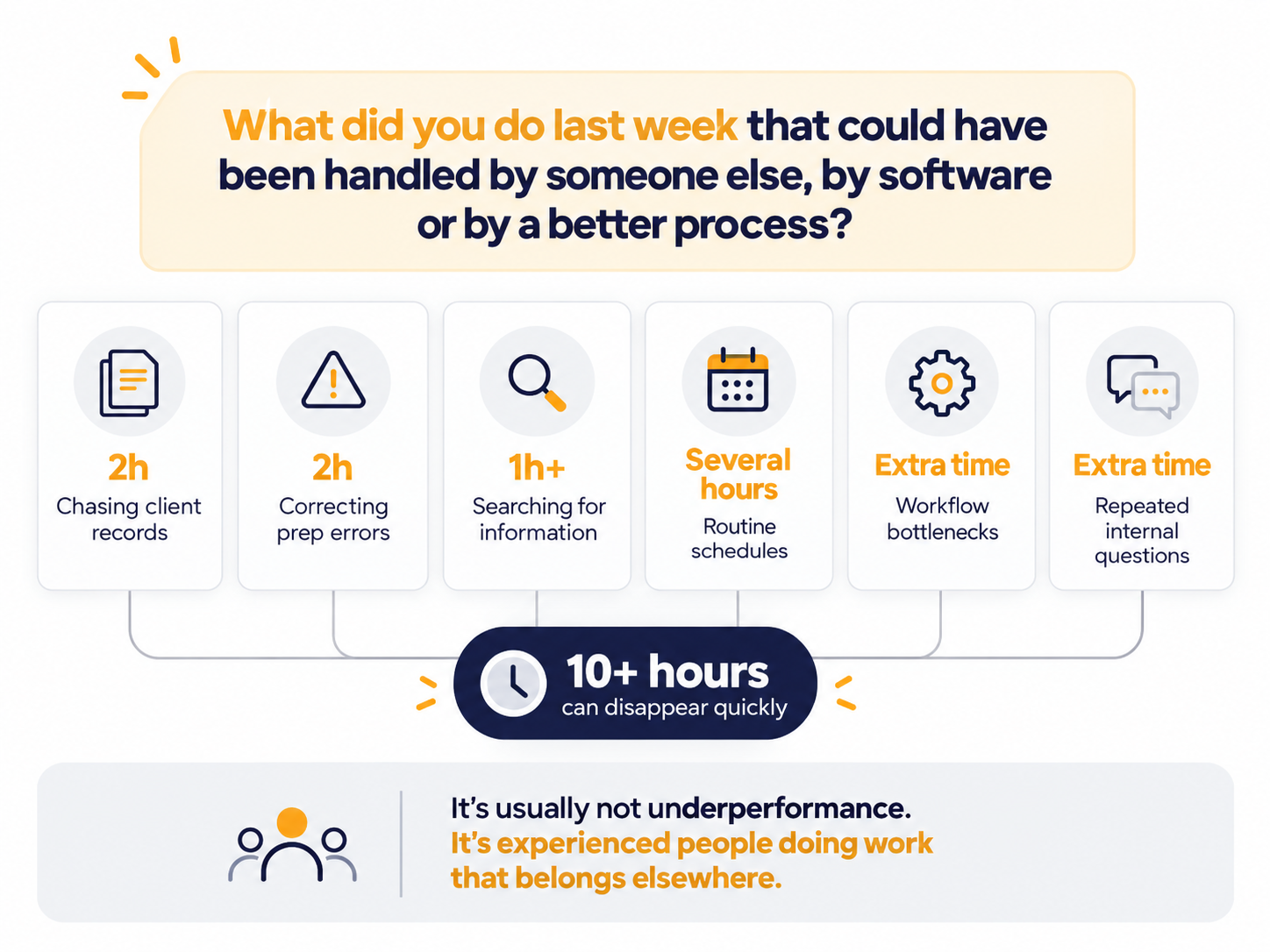
One of the simplest ways to identify wasted capacity is to ask every partner and manager a straightforward question: What did you do last week that could have been handled by someone else, by software or by a better process? The answers are often revealing. A typical week might include two hours chasing client records, two hours correcting basic preparation errors, an hour or more searching for information, several hours preparing routine schedules and further time dealing with workflow bottlenecks or repeated internal questions. It does not take many of these small tasks to reach ten hours. That does not mean the team is underperforming. More often, it means highly experienced people are doing work that belongs elsewhere.
Stop Senior Staff Doing Routine Preparation
The biggest opportunity in many firms is to reduce the amount of preparation work handled by managers and partners. Senior staff often step into routine work because they can complete it quickly and want to keep deadlines moving. This can solve an immediate problem, but it also creates dependency. If a partner spends three hours preparing accounts because the team is overloaded, those three hours are no longer available for client meetings, tax planning, pricing, advisory work, business development or leadership. The better solution is to strengthen the preparation layer. That may involve better delegation, improved processes, automation or outsourced accounting support. Senior staff should spend the majority of their time on review, judgement, technical work and client relationships rather than routine preparation.
Automate Predictable Client Chasing
Client chasing is one of the easiest ways for accounting teams to lose time. An employee sends a reminder, waits for a response, checks again later and sends another follow-up. When this happens across dozens or hundreds of clients, the time adds up quickly. A more efficient approach is to automate the predictable stages of the process. For example, the first and second reminders can be automated. A team member only becomes involved when a specific piece of information is missing or when the client repeatedly fails to respond. This means human time is reserved for exceptions rather than routine administration. It also creates a more consistent process because every client receives reminders at the right stage without relying on someone remembering to send them.
Do Not Start Jobs Before They Are Ready
Starting incomplete jobs creates hidden duplication. An accountant opens a file, works on it for a while, discovers that important information is missing and has to stop. When the records eventually arrive, the accountant must reopen the job and spend time remembering what had already been completed. Across a large client base, this stop-start pattern can consume many hours. A simple ready-for-work check can reduce the problem. Before a job enters preparation, the firm should confirm that the minimum required records and information are available. If something important is missing, the job should remain in a clearly defined waiting stage with a named owner responsible for chasing the outstanding information. This keeps preparation time focused on work that can actually be completed.
Reduce Review Rework
Review is expensive because it is normally performed by managers and partners. If the same errors repeatedly reach the review stage, senior time is being wasted. Common examples include incomplete reconciliations, missing documents, incorrect coding, weak working-paper references and unexplained balances. The solution is not to make managers review faster. The solution is to improve first-pass quality. Standard checklists, clearer working-paper expectations and better preparation processes can reduce the amount of routine correction required during review. That can create a significant time saving because one hour removed from manager review is often worth more than one hour removed from basic preparation.
| Time Drain | Typical Weekly Loss | Better Approach |
|---|---|---|
| Client chasing | 1–2 hours | Automated reminders |
| Repeated review points | 2–3 hours | Standard checklists |
| Routine preparation | 2–4 hours | Delegate or outsource |
| Searching for information | Around 1 hour | Centralise records |
| Internal questions | 1–2 hours | SOPs and escalation rules |
| Workflow chasing | Around 1 hour | Clear task ownership |
Even modest improvements across these areas can free substantial senior capacity.
Create One Reliable Place for Information
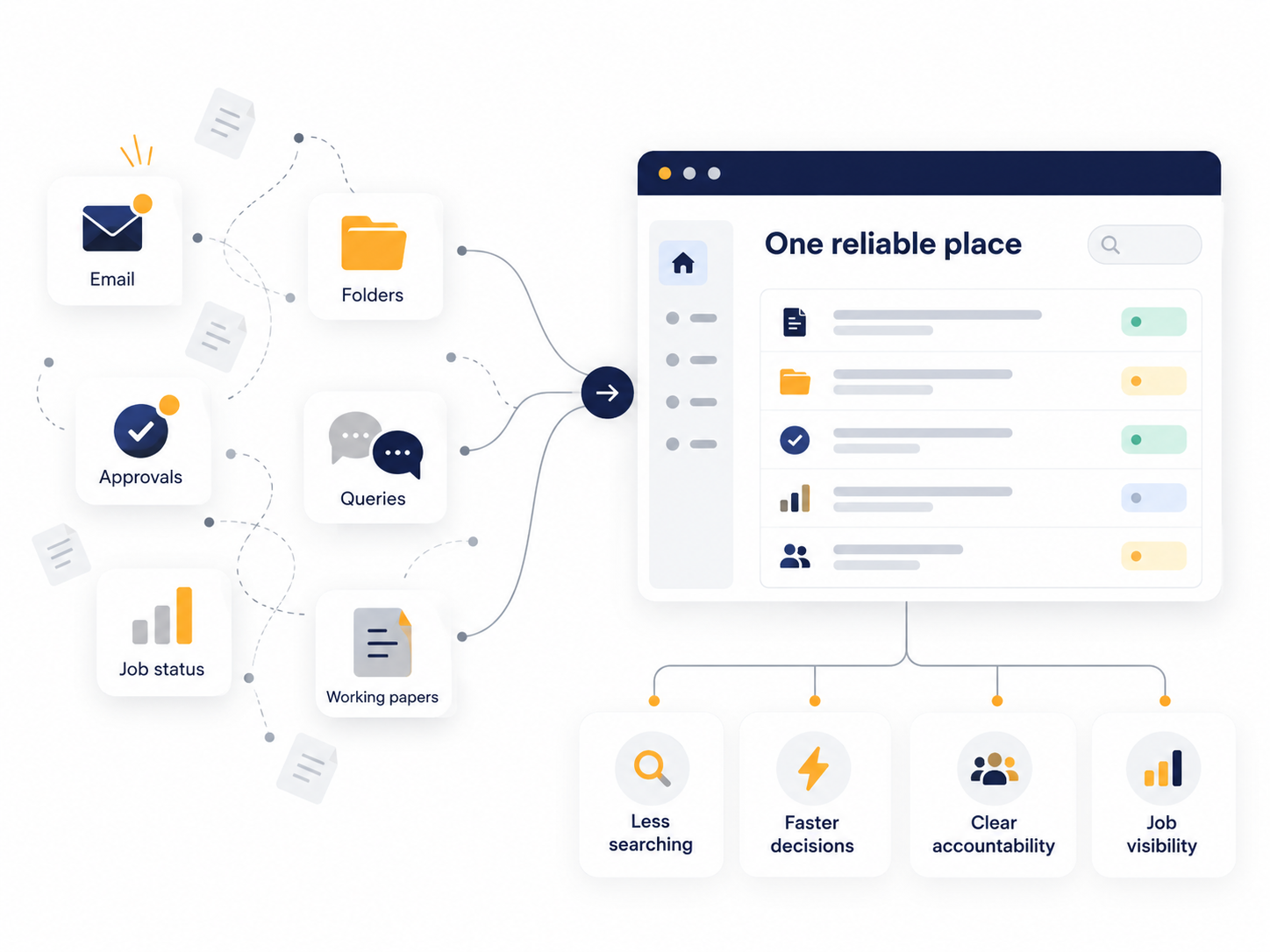
A surprising amount of time is lost simply trying to find information. Where is the client approval? Has the bank statement arrived? Did someone already raise this query? Which version of the working paper is current? Searching for answers does not improve the client outcome, but it still consumes expensive time. Every accounting firm should have a recognised location for client documents, working papers, open queries, review points, approvals, filing evidence and job status. The aim is simple: nobody should need to search through multiple inboxes, spreadsheets and folders just to understand what is happening with a job. Centralising information improves both speed and accountability.
Document Repeated Answers
Managers often spend time answering the same internal questions repeatedly. Some questions genuinely require judgement. Many do not. If team members regularly ask where a schedule should be saved, how to handle a routine client request or what happens when information is late, those answers should be documented. Simple standard operating procedures can cover the most common 80% of situations, while unusual cases can still be escalated. This reduces interruptions and prevents senior employees from becoming permanent internal help desks. It also makes onboarding easier because new employees have a clearer reference point.
Use Outsourcing as Capacity, Not Just Cost Saving
One reason firms struggle to reclaim time is that routine work still needs to be completed somewhere. If the internal team is already at capacity, delegation alone may not solve the problem. This is where outsourced accounting support can be useful. A dedicated offshore team can support recurring work such as bookkeeping, bank reconciliations, VAT preparation, payroll support, accounts working papers and routine management accounts schedules. The UK practice can retain responsibility for client communication, technical judgement, review and final approval. The purpose is not to replace the UK team. It is to stop experienced staff spending too much of their week on preparation work that can be completed elsewhere under an agreed process.
Make Workflow Ownership Obvious
A surprising amount of time is also lost asking one basic question: Who is dealing with this? Every job should have a clearly defined current stage, named owner, next action and target date. If a workflow system only says that a job is “in progress”, that is not enough information. Managers should be able to see immediately whether a job is waiting for client records, in preparation, awaiting review or blocked by an issue. Good workflow visibility reduces the need for status chasing and unnecessary meetings.
Replace Status Meetings With Exception Meetings
Meetings can become another hidden drain on capacity. A one-hour meeting with eight people consumes eight hours of firm time. Some meetings are essential, but many simply involve people verbally reporting information that should already be visible in the workflow system. A more efficient approach is to focus meetings on exceptions. Discuss only jobs at risk, missing information, review bottlenecks, technical problems and deadlines requiring action. Everything else should be visible in the system and should not require discussion. In many firms, a short exception-based meeting can replace a much longer general status update.
Protect the Time You Recover
Creating free time is only half the job. If managers reclaim ten hours a week and immediately fill those hours with more routine administration, nothing has really changed. Firms should decide in advance how recovered capacity will be used. Partner time may be redirected towards advisory work, business development and key clients. Manager time can be used for review, coaching and complex work. Senior accountants can take on higher-level preparation and more client responsibility. This is what turns operational efficiency into commercial value.
Run a One-Week Time Audit
A simple one-week time audit can help identify where capacity is being lost. Ask partners and managers to record time spent on chasing, rework, searching, routine preparation, internal questions, workflow administration and restarting incomplete jobs. At the end of the week, total the hours. Then ask a more useful question than whether the work was billable: Did this task need to happen at all, and did it need to be done by this person? That is where the biggest opportunities usually appear. A task can be billable and still be a poor use of senior time.
You Do Not Need More Hours in the Week
Most accounting firms do not have a time problem as much as they have an allocation problem. Highly experienced people are often spending too much time on work that can be automated, standardised, delegated or supported elsewhere. When that work is moved to the right level, capacity begins to appear without increasing the working week. The most effective firms do not simply ask their teams to work harder. They design workflows that make better use of each person's time. WIS BPO provides dedicated accounting support for UK practices that want to reduce routine preparation pressure and protect senior capacity. Our teams work within agreed workflows and review structures, while the UK practice retains client relationships, technical responsibility and final approval.
FAQs
Can accountants really save 10 hours a week?
Yes, particularly where partners and managers are heavily involved in routine preparation, client chasing, rework and workflow administration. The exact saving will depend on the firm's existing processes.
What should accounting firms delegate first?
Start with recurring, standardised work such as bookkeeping, reconciliations, VAT preparation and routine accounts schedules.
Can outsourcing save senior accountants time?
Yes. A structured outsourced preparation team can reduce routine workload and allow UK managers and partners to focus on review, technical work and client relationships.
Does automation replace accountants?
Usually not. Automation is most effective for repetitive administration and predictable processes. Human judgement remains essential for exceptions, technical decisions and client advice.
How should firms measure time savings?
Track how many partner and manager hours are spent on preparation, rework, chasing and administration before and after changes are introduced.
Is hiring still necessary?
Sometimes. However, firms should first determine whether they have a genuine capacity shortage or whether existing people are simply being used inefficiently.