
TL;DR
Meeting filing deadlines consistently is one of the most important operational challenges facing accounting firms. In most cases, missed deadlines are not caused by a single major failure. They develop gradually as client records arrive late, bookkeeping takes longer than expected, reconciliations raise queries, review queues grow and final approvals are delayed.
- Author
- WIS BPO
- Published
- Published
- Last updated
- Updated
- Reading time
- 5 min read
- Category
- Strategy
Meeting filing deadlines consistently is one of the most important operational challenges facing accounting firms. In most cases, missed deadlines are not caused by a single major failure. They develop gradually as client records arrive late, bookkeeping takes longer than expected, reconciliations raise queries, review queues grow and final approvals are delayed. The problem is often not the statutory deadline itself. It is the way the firm manages the work leading up to it. One of the simplest ways to improve accounting filing deadline management is to stop treating the statutory filing date as the true working deadline. Instead, firms can create an earlier internal deadline and build the entire workflow around that date. This creates a valuable buffer for preparation, review, corrections, client queries and unexpected delays. It also gives managers more time to intervene before a routine issue becomes a deadline emergency.
Stop Managing Work Around the Statutory Filing Date
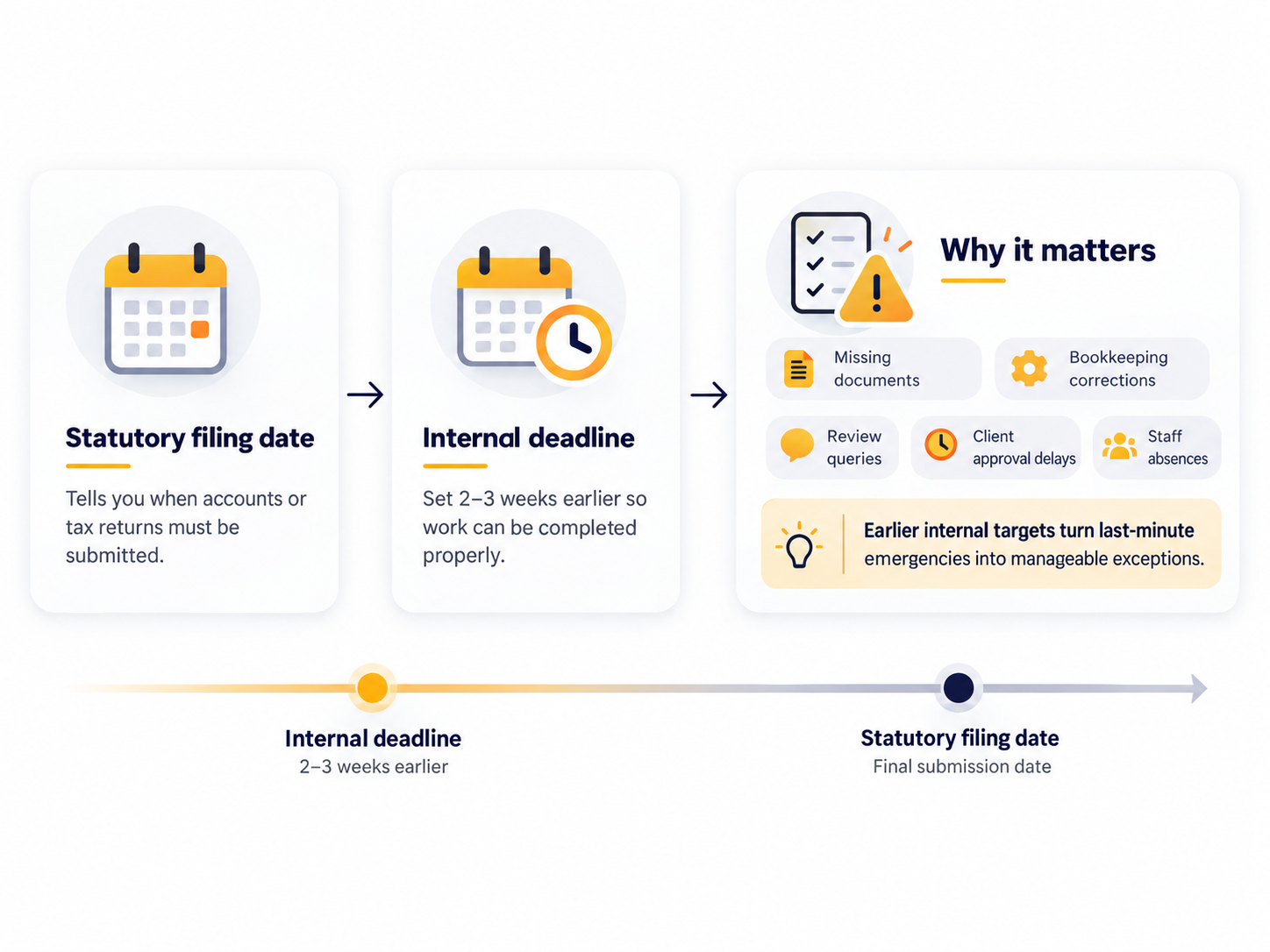
A statutory filing date tells you when accounts, tax returns or other compliance documents must be submitted. It does not tell you when preparation should begin or when each stage of the process should be completed. That distinction is essential. If a set of accounts is due at the end of the month, the internal completion target might be two or three weeks earlier. This gives the firm enough time to complete the work properly rather than trying to finish everything just before the deadline. The purpose of an internal deadline is not simply to file early. It is to create enough space to deal with the problems that inevitably arise during the process. These may include missing documents, bookkeeping corrections, review queries, client approval delays or unexpected staff absences. When firms manage towards an earlier internal date, these issues become manageable exceptions rather than last-minute emergencies.
Work Backwards From the Final Deadline
A practical filing deadline management system starts with the statutory deadline and works backwards through each stage of the job. A typical accounts workflow might look like this:
| Stage | Example Timing |
|---|---|
| Statutory filing deadline | Day 0 |
| Final submission | Day -5 |
| Client approval | Day -10 |
| Manager review | Day -15 |
| Preparation complete | Day -20 |
| Client records received | Day -30 |
The exact timetable will depend on the type and complexity of the work, but the principle remains the same. Each stage should have its own target date. This gives managers several opportunities to identify a delay before the statutory filing date is affected. If client records have not arrived by the agreed date, the team can chase the client immediately. If preparation misses its internal deadline, the job can be escalated while there is still time to recover. This is one of the biggest advantages of structured accounting filing deadline management: problems become visible earlier.
Give Every Job Clear Ownership
A deadline is only useful when someone is responsible for achieving it. Every compliance job should have a clearly identified owner who knows where the job stands, what needs to happen next and who is responsible for the next action. This does not mean that one person has to complete the entire assignment. A bookkeeper may prepare the records, an accountant may prepare the accounts and a manager may review them. However, there should always be clear ownership at each stage. Without this, jobs can remain untouched because everyone assumes that somebody else is dealing with them. Clear ownership improves accountability and reduces the risk of work becoming lost in the workflow.
Track Workflow Stages as Well as Deadlines
Many firms already use practice management software to monitor filing dates. However, knowing when a job is due is only part of the picture. Two jobs may both have the same statutory deadline, but their risk levels may be completely different. One may already be prepared and waiting for review. Another may still be waiting for the client to provide bank statements. Those jobs should not be treated in the same way. A more effective workflow tracks the actual stage of each job, for example:
- Waiting for client information
- Ready to start
- In preparation
- Awaiting review
- Returned for correction
- Awaiting client approval
- Ready to submit
- Filed
This allows managers to see where work is becoming blocked and which areas require attention. It also makes capacity planning more accurate because firms can distinguish between work that is genuinely progressing and work that is simply sitting in a queue.
Use a Simple Risk System
Accounting workflow management does not need to be overly complicated. A straightforward traffic-light system can help teams prioritise jobs and identify those that need intervention.
| Status | Meaning | Action |
|---|---|---|
| Green | On track for internal deadline | Continue normally |
| Amber | Delay or issue emerging | Owner investigates |
| Red | Internal deadline at risk | Manager escalation |
| Critical | Statutory deadline may be affected | Senior intervention |
The key principle is that jobs should become red before the statutory deadline is under threat. If a job is only flagged as high risk in the final few days before submission, the system is not providing enough warning.
Give Clients Their Own Information Deadlines
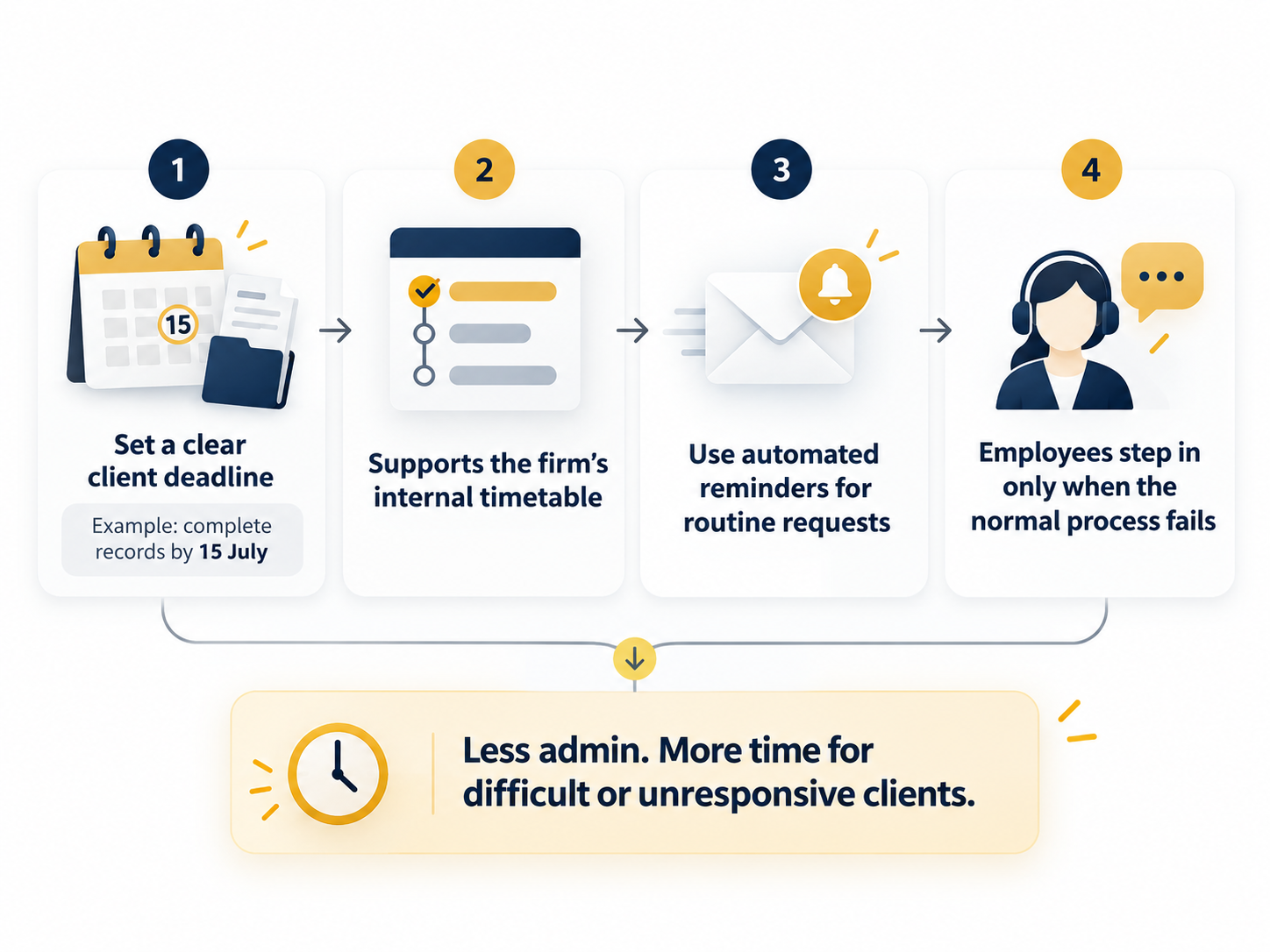
Client delays are one of the most common causes of filing pressure. Accounting firms cannot completely control when clients provide information, but they can make expectations much clearer. Instead of telling a client that their accounts are due in September, it is more useful to say that complete records are required by a specific date, such as 15 July. This creates a practical client deadline that supports the firm's internal timetable. Automated reminders can then be used to chase routine information requests, while employees step in only when the normal process fails. This helps reduce unnecessary administrative work and gives the firm more time to manage difficult or unresponsive clients.
Make Sure Jobs Are Ready Before Preparation Begins
Starting work too early can be surprisingly inefficient. An accountant may begin preparing a set of accounts only to discover that several important documents are missing. The job then stops, returns to the queue and has to be restarted later. This creates repeated work and makes the workflow appear more advanced than it actually is. A readiness checklist can solve this problem. Before a job moves into preparation, the firm should confirm that the essential records and information are available. If they are not, the job should remain in a clear waiting-for-information stage. This makes workload reporting more accurate and helps managers understand how much work is genuinely ready to be processed.
Protect the Review Stage
Firms often concentrate heavily on preparation capacity but pay less attention to review capacity. This can create a hidden bottleneck. A job may be prepared well before the deadline but still remain unfinished because it sits in a manager's review queue for several days or weeks. Preparation and review should therefore have separate internal deadlines. Managers should monitor the number of files awaiting review, how long those files have been waiting, which deadlines are approaching and whether there is enough reviewer capacity available. If the review queue continues to grow, increasing preparation capacity alone may actually make the problem worse.
Build Escalation Into the Workflow
Teams should not need to decide from scratch when a delay becomes serious. A clear escalation process can make deadline management more consistent. For example, client records that are seven days late might trigger an automated reminder. If they are still missing after fourteen days, the job may be escalated to the account manager. Similarly, a missed preparation deadline may trigger manager involvement, while a missed review deadline may require senior management attention. The aim is to make escalation predictable. This prevents senior people from being pulled into every minor issue while ensuring that genuine deadline risks receive attention early enough.
Identify Capacity Problems Before Busy Season
One of the biggest benefits of internal deadlines is that they reveal future capacity problems earlier. Suppose a firm's workflow shows that 120 sets of accounts need to be prepared in November, but the internal team can realistically complete only 90. If that gap becomes visible in September, the firm has time to respond. It may be able to redistribute work, improve internal processes, adjust timelines or add additional outsourced accounting support. If the same capacity problem is only discovered in late November, the firm has far fewer options. Outsourced teams can provide additional support for structured and repeatable work such as bookkeeping, reconciliations, VAT preparation and accounts working papers. The UK practice can continue to retain responsibility for technical judgement, client communication, review and final approval while the outsourced team supports preparation capacity. The important point is to add capacity before the workflow reaches crisis point.
Focus Daily Reviews on Exceptions
During busy periods, deadline meetings do not need to become lengthy discussions about every open job. A more efficient approach is to review exceptions. Managers can focus on jobs that have missed internal deadlines, clients who have not provided records, files that are blocked, review queues that are growing and jobs that may move into red status. This keeps attention on the areas where intervention can make the greatest difference. It also helps firms avoid wasting management time reviewing work that is progressing normally.
Measure Early Completion
Many accounting firms measure performance by asking whether statutory deadlines were missed. That is important, but it is a lagging indicator. By the time a deadline has been missed, the workflow failure has already occurred. More useful measures may include the percentage of jobs completed before the internal deadline, the number of files waiting for client information, average time spent in review, the number of red-status jobs and the number of files requiring partner intervention. These measures provide earlier warning signs. A firm that consistently completes work several weeks before the filing deadline is operating with far more resilience than one that files everything on the final day. Both firms may achieve the same technical compliance result, but their operational risk is very different.
Make the Internal Deadline the Real Deadline
Strong accounting firms do not rely on last-minute effort to keep compliance work on track. They create enough space in the process to deal with delays before those delays become serious. The statutory filing date remains the final legal boundary, but the internal deadline becomes the true operational target. This approach gives teams time to deal with late records, difficult reconciliations, review queries, client delays and unexpected staffing issues without every problem turning into an emergency. Effective accounting filing deadline management therefore comes down to a few core principles: set internal deadlines earlier, give every job clear ownership, track workflow stages, escalate problems quickly and maintain enough capacity to keep work moving. WIS BPO supports UK accounting practices that want to build more predictable compliance workflows. Our teams can assist with recurring preparation work within agreed processes and internal deadlines, while your UK practice retains client relationships, technical responsibility, review and final approval.
FAQs
How can accounting firms avoid missing filing deadlines?
Accounting firms can reduce missed deadlines by setting internal completion dates ahead of statutory filing dates, assigning clear ownership and tracking each job by workflow stage. Delays should be identified and escalated before the statutory deadline is at risk.
How far ahead should internal filing deadlines be?
There is no single timetable that works for every service. The internal deadline should allow sufficient time for preparation, review, corrections, client questions and approval.
Why do accounting firms miss deadlines despite using workflow software?
Software can track dates and statuses, but it cannot solve unclear ownership, late client information, poor processes or insufficient capacity. The underlying workflow still needs to be managed properly.
Should client information deadlines be separate from statutory deadlines?
Yes. Clients should be given a clear date by which complete records must be provided. That date should be sufficiently early to allow preparation, review and approval before submission.
Can outsourcing help with accounting filing deadlines?
Yes. Outsourced accounting teams can provide additional preparation capacity during busy periods while the UK firm retains control of review, technical judgement, client communication and final approval.
What is the best filing deadline metric to track?
The percentage of jobs completed before the firm's internal deadline can provide a stronger indication of workflow health than simply measuring whether statutory deadlines were missed.