

TL;DR
Payroll outsourcing can reduce workload, but the wrong provider can expose your firm to compliance, security and client-service risks. Here are the warning signs to review in 2026.
- Author
- WIS BPO
- Published
- Published
- Last updated
- Updated
- Reading time
- 5 min read
- Category
- Payroll
Payroll is often seen as one of the easiest accounting functions to outsource. It is repetitive, follows regular cycles and is supported by software that automates much of the calculation and reporting. However, that apparent simplicity can be misleading. Your payroll provider may have access to employee salaries, bank details, National Insurance numbers, pension information and tax data. At the same time, they may also be responsible for meeting fixed HMRC reporting deadlines and ensuring employees are paid correctly and on time. That combination makes payroll one of the most sensitive areas of outsourced accounting. If bookkeeping runs a day late, there may still be time to recover. If payroll fails just before payday, the consequences are immediate. For accounting firms, the risk is even greater because clients usually hold the firm responsible, regardless of whether an outsourced provider caused the problem.
Payroll Deadlines Leave Very Little Room for Error
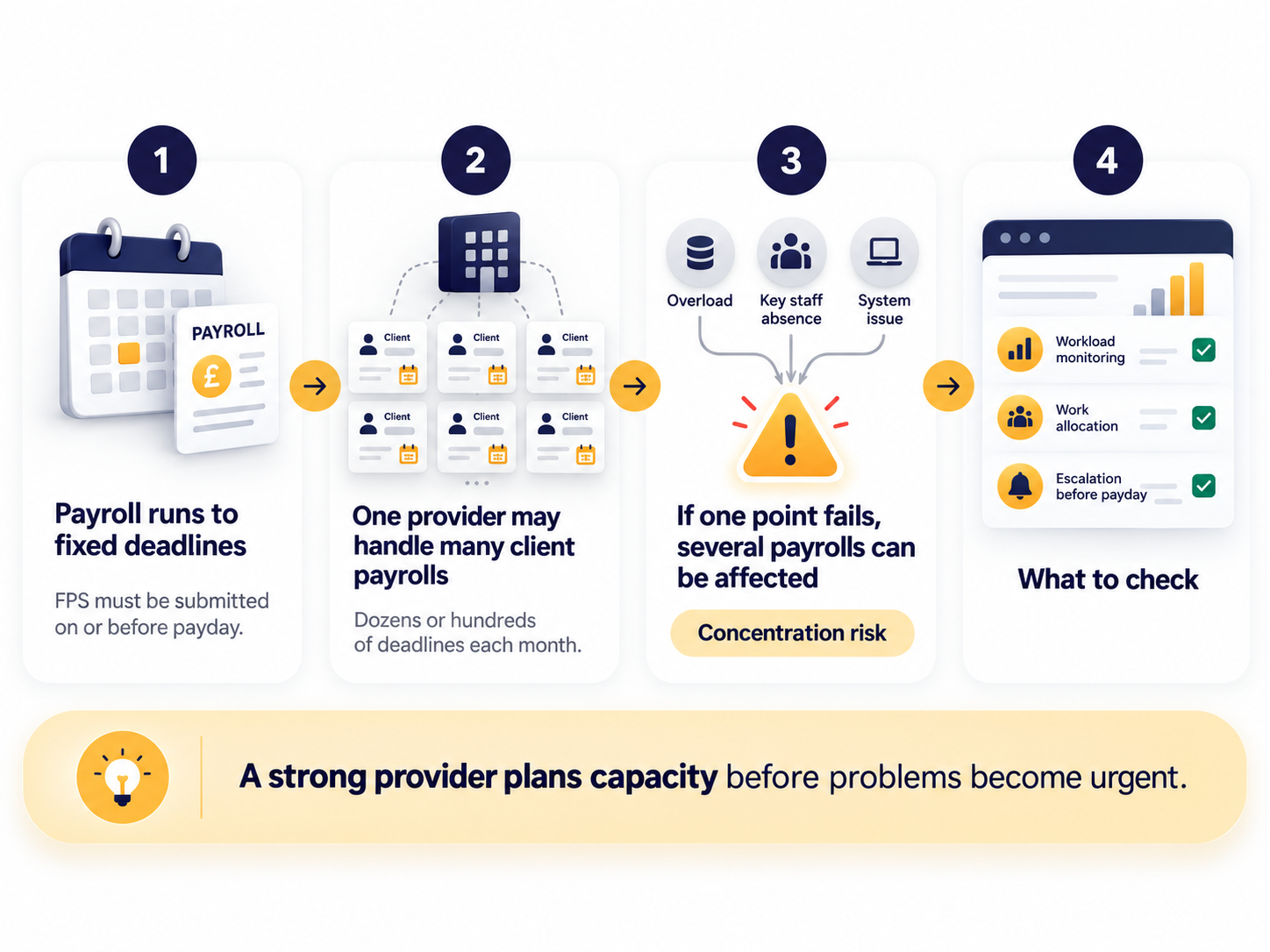
Payroll operates on fixed deadlines. Employers generally need to report employee payments and deductions to HMRC through a Full Payment Submission on or before payday. For an accounting firm managing multiple client payrolls, this means one outsourced provider may be responsible for dozens or even hundreds of deadlines every month. If that provider becomes overloaded, loses a key member of staff or experiences a system issue, several client payrolls could be affected at the same time. This creates what is known as concentration risk. The key question is therefore not simply whether your provider has met deadlines in the past. You should also understand how they monitor workload before payday and what happens when capacity becomes stretched. A strong provider should be able to explain how deadlines are monitored, how work is allocated and how problems are escalated before they become urgent.
Payroll Data Is Highly Sensitive
Payroll providers may handle some of the most sensitive information held by a business. This can include:
- Employee names and addresses
- National Insurance numbers
- Salary details
- Bank account information
- Pension records
- Tax information
- Employment records
That means payroll data security should be treated as a core part of provider selection and review. Your provider should be able to explain who has access to each client payroll, how that access is controlled and how information is protected. If data is accessed or processed outside the UK, additional considerations around international data transfers may also apply depending on the arrangement. A vague statement that a provider is “GDPR compliant” is not enough. What matters is how their controls work in practice.
Ask Practical Security Questions
When reviewing payroll provider risks, practical questions often reveal more than policy documents. Ask who can access client payroll data and whether multi-factor authentication is required. Find out whether employees can download payroll information onto local devices and how quickly system access is removed when somebody leaves the organisation. You should also ask whether subcontractors are used, where payroll data is being accessed from and how security incidents are reported. The answers will give you a much clearer view of the provider's actual security environment. A provider that cannot explain these controls clearly may create unnecessary risk for your practice and your clients.
Bank-Detail Changes Can Create Fraud Risk
One of the most sensitive areas in payroll is changing employee bank details. Imagine an email arrives appearing to come from an employee asking for their salary to be paid into a new bank account. The request looks genuine, so the provider updates the payroll record. However, the employee's email account has actually been compromised. Without proper verification, payroll processes can become a route for payment fraud. A strong payroll provider should therefore have a clear procedure for verifying high-risk changes. This could involve independent confirmation through an approved contact method rather than relying solely on the email requesting the change. One of the most useful questions to ask a provider is: How do you independently verify changes to employee bank details? If the answer is unclear, the control may not be strong enough.
Workplace Pensions Add Another Layer of Responsibility
Payroll is also closely connected with workplace pension obligations. Employee assessments, pension deductions and contribution information often depend on payroll data. This means poor payroll administration can create additional problems around automatic enrolment, contributions and employee records. One common source of difficulty is unclear responsibility. The payroll provider may assume the accounting firm is handling a pension task, while the accounting firm assumes the provider is responsible. If nobody clearly owns the process, important steps can be missed. For this reason, firms should document the exact boundary between payroll processing, pension administration and the employer's own responsibilities.
Where Payroll Provider Risk Commonly Appears
| Risk Area | What Can Go Wrong | Stronger Control |
|---|---|---|
| RTI deadlines | Payroll reported late | Deadline monitoring and escalation |
| Staff absence | Processing stops | Documented backup cover |
| Bank-detail changes | Fraudulent account accepted | Independent verification |
| Payroll errors | Employees paid incorrectly | Pre-processing review |
| Data access | Too many people see records | Role-based permissions |
| Staff departures | Former staff retain access | Immediate access removal |
| Pension processing | Records or contributions incorrect | Clear ownership |
| System outage | Payroll cannot be completed | Business continuity process |
A reliable provider should be able to explain how each of these risks is managed without relying on vague marketing statements.
Do You Depend on One Payroll Processor?
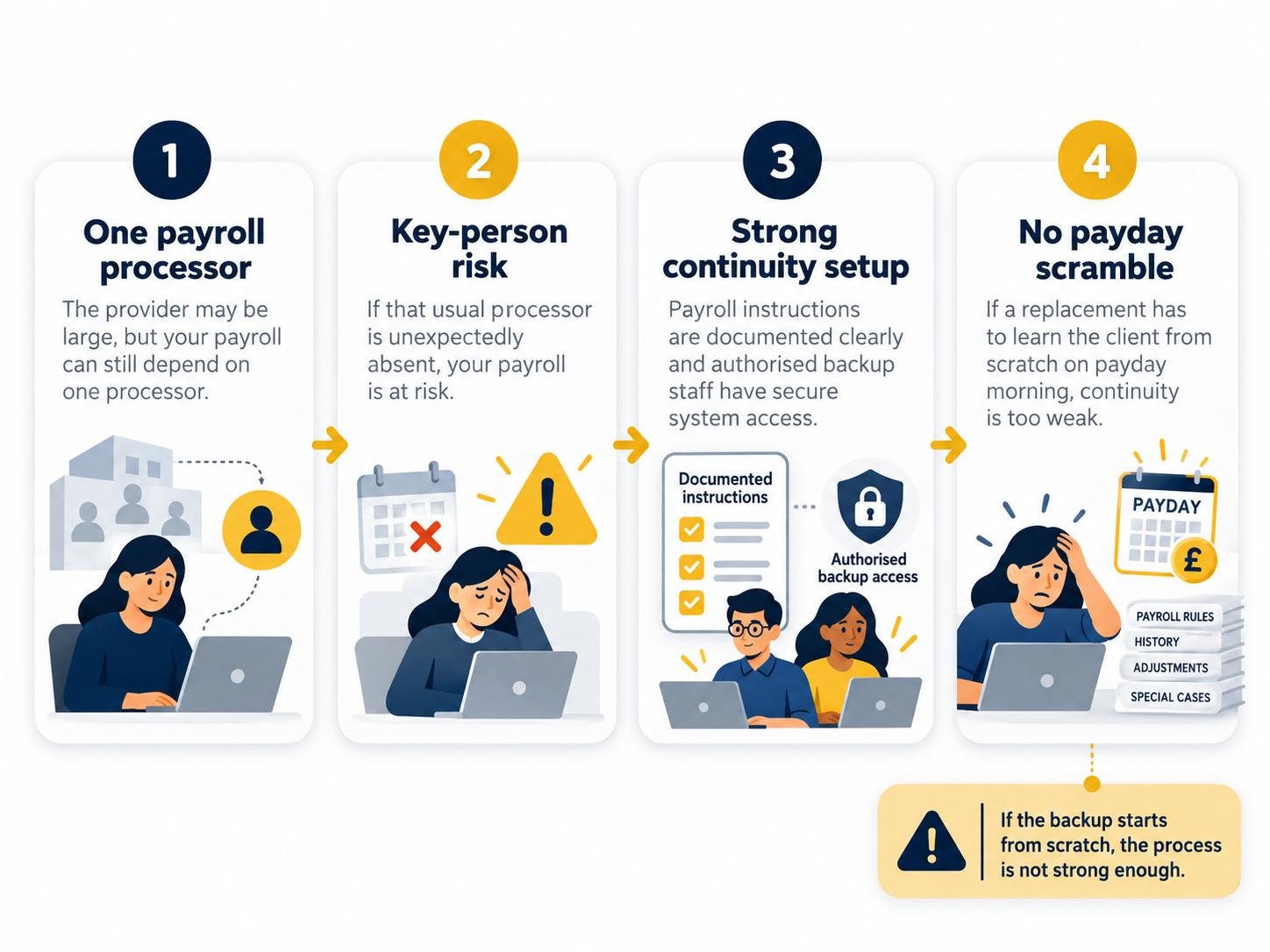
A provider may employ dozens or even hundreds of people, but your payroll could still depend on one individual. This creates key-person risk. If that person becomes unexpectedly unavailable, someone else should be able to continue the work without disruption. Payroll-specific instructions should therefore be documented clearly, and authorised backup staff should have secure access to the systems they need. Ask what happens if your usual processor is absent on the day payroll must be completed. If the replacement has to begin learning the client from scratch on payday morning, the continuity process is not strong enough.
Cheap Payroll Can Become Expensive
The monthly outsourcing fee should not be the only factor considered when choosing a payroll provider. Suppose one provider charges £300 per month while another charges £450. The cheaper provider may appear to offer better value. However, if your manager spends five additional hours each month correcting errors, answering queries and reviewing inconsistent work, the apparent saving may disappear quickly. A better way to assess value is to look at total delivery cost: Total delivery cost = provider fee + internal review time + corrections + management time This is particularly important for accounting firms because senior review time is both expensive and limited. A provider that costs slightly more but delivers accurate work consistently may offer much better value overall.
Poor Escalation Can Turn Small Problems Into Emergencies
Even strong payroll teams will occasionally encounter unusual situations. A client may send information late. An employee may dispute their pay. A pension file may fail. A payroll value may change unexpectedly. A system may stop responding. The problem is not that these situations occur. The real issue is how quickly they are identified and escalated. A well-structured payroll provider should know which issues can be resolved independently, which require manager involvement, which need client approval and which must be escalated to the UK accounting firm immediately. Without clear escalation rules, small issues can remain unnoticed until payday.
Your Client Will Hold You Responsible
For accounting practices, the biggest payroll outsourcing risk may be reputational. Your clients may never speak directly to the outsourced payroll provider. They hired your firm. If an employee is paid incorrectly or payroll information is submitted late, the client is unlikely to distinguish between your internal team and your outsourced provider. The accounting firm owns the relationship. That means payroll outsourcing should not be judged solely by speed or cost. Reliability, communication, security and escalation are equally important. A provider should strengthen your client service rather than create an additional layer of uncertainty.
Make Sure You Have an Exit Plan
One of the most overlooked payroll provider risks is the difficulty of changing providers. Before entering or renewing an outsourcing arrangement, consider what would happen if you decided to leave. Would you be able to obtain:
- Payroll history
- Employee records
- Pension information
- Current-period data
- Outstanding queries
- Client-specific instructions
- Filing evidence
You should also know how quickly system access can be transferred and whether the provider has a documented handover process. A good outsourcing relationship should make your firm more flexible. It should not make leaving the provider operationally dangerous.
Stress-Test Your Payroll Provider
Rather than simply asking whether your payroll provider is reliable, give them realistic scenarios and ask how they would respond. For example: “Your main payroll processor is absent tomorrow. What happens?” “An employee asks to change their bank details four hours before payroll is processed. What happens?” “Your payroll system becomes unavailable on processing day. What happens?” “A possible data breach is identified overnight. Who contacts us and how quickly?” “The client sends late information after payroll has already been approved. Who decides what happens next?” Specific questions produce much more useful answers than general assurances. They reveal how the provider actually operates when something goes wrong.
How to Reduce Payroll Outsourcing Risk
Payroll outsourcing can be highly effective when the relationship is properly structured. The strongest arrangements usually include clear service responsibilities, documented processes, controlled system access, backup staff, defined cut-off dates and formal escalation routes. Accounting firms should also review provider performance regularly rather than assuming that a relationship that worked well two years ago remains equally strong today. Useful areas to review include payroll accuracy, missed deadlines, correction levels, staff turnover, security incidents and the amount of internal review time required. This creates a more complete picture of provider performance.
Payroll Is a Small Service Until Something Goes Wrong
Payroll may represent only one part of an accounting firm's overall service, but it sits at the intersection of employees, money, HMRC reporting, workplace pensions and sensitive personal information. That makes payroll failures unusually visible. The strongest payroll outsourcing relationship is not necessarily the one that processes payslips at the lowest price. It is the one that continues to operate reliably when information arrives late, a team member is absent, a system fails or an unusual issue requires immediate attention. Accounting firms reviewing their payroll arrangements in 2026 should therefore look beyond price and basic processing capability. They should examine continuity, data security, fraud controls, escalation procedures, backup arrangements and the ease of transferring the service if circumstances change. WIS BPO provides dedicated payroll and accounting support for UK practices through structured teams, documented processes and defined escalation routes. Our teams support recurring payroll delivery while the UK practice retains client communication, professional oversight and final control.
FAQs
What is the biggest risk when outsourcing payroll?
The biggest risk is usually weak control over a highly time-sensitive process. Poor continuity, security or escalation can affect employee pay, compliance and client relationships at the same time.
How can accounting firms reduce payroll outsourcing risk?
Firms can reduce risk by defining clear responsibilities, controlling system access, maintaining documented backup arrangements, setting cut-off dates and establishing formal escalation procedures.
How should payroll providers protect employee data?
Access should be restricted to authorised people and supported by appropriate security controls, multi-factor authentication where appropriate, clear staff-access procedures and documented incident-response processes.
Is outsourced payroll safer than processing payroll internally?
Either approach can be safe or risky. The quality of the people, systems, controls, documentation and continuity arrangements matters more than whether the work is performed internally or externally.
What should happen if a payroll processor is absent?
A trained replacement should be able to continue the work using documented client instructions and secure authorised access to the relevant systems.
How often should a payroll provider be reviewed?
Accounting firms should review payroll providers regularly, paying particular attention to accuracy, deadlines, corrections, staff changes, security issues and the amount of internal management time required.


